
Santa Fe Contemporary Hispanic Market 2026: Your Complete Visitor’s Guide
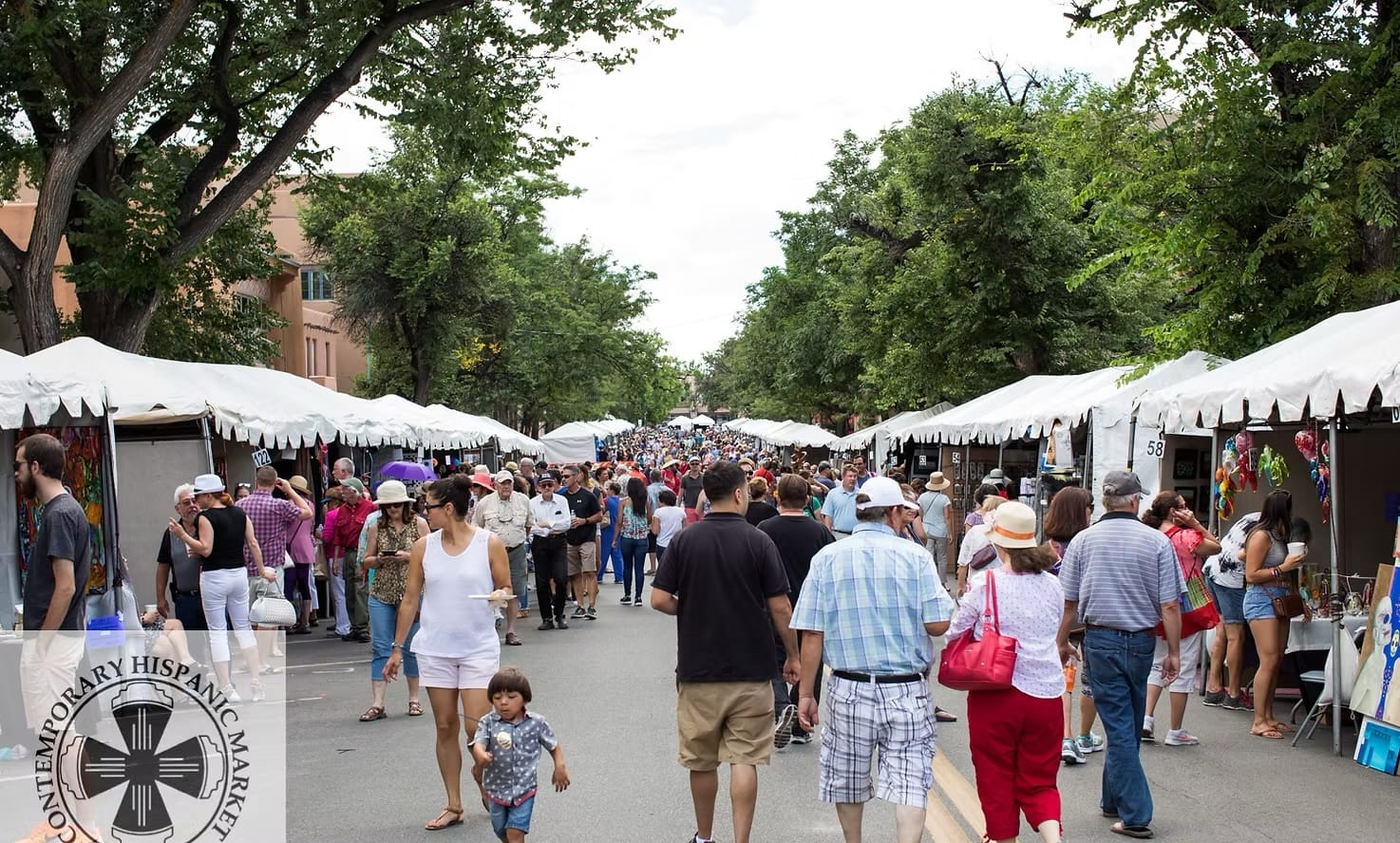
Lincoln Avenue hums with possibility on a July morning in Santa Fe. White-tented booths stretch north from the Plaza, each one a window into a living, breathing artistic tradition — not centuries old, but vibrantly, defiantly of right now. A bronze sculptor adjusts a piece she finished last month. A mixed-media artist layers acrylic over photographs of her grandmother’s hands. A writer sells novels set in the enchanted landscapes outside his Taos window. This is the Santa Fe Contemporary Hispanic Market, and there is nothing else quite like it in the world.
Every July, on the last full weekend of the month, Lincoln Avenue comes alive with more than 130 juried Hispanic artists — all New Mexico residents — who bring the full range of contemporary creative expression to one remarkable open-air market. It runs alongside the Traditional Spanish Market on the same weekend, creating a side-by-side celebration of Hispanic art that spans five centuries of cultural evolution. In 2026, that weekend falls on Saturday and Sunday, July 25 and 26.
This guide covers everything you need: the history, the art, the logistics, the insider tips, and — crucially — where to stay so the market becomes the anchor of a genuinely memorable Santa Fe weekend rather than a stressful day trip.
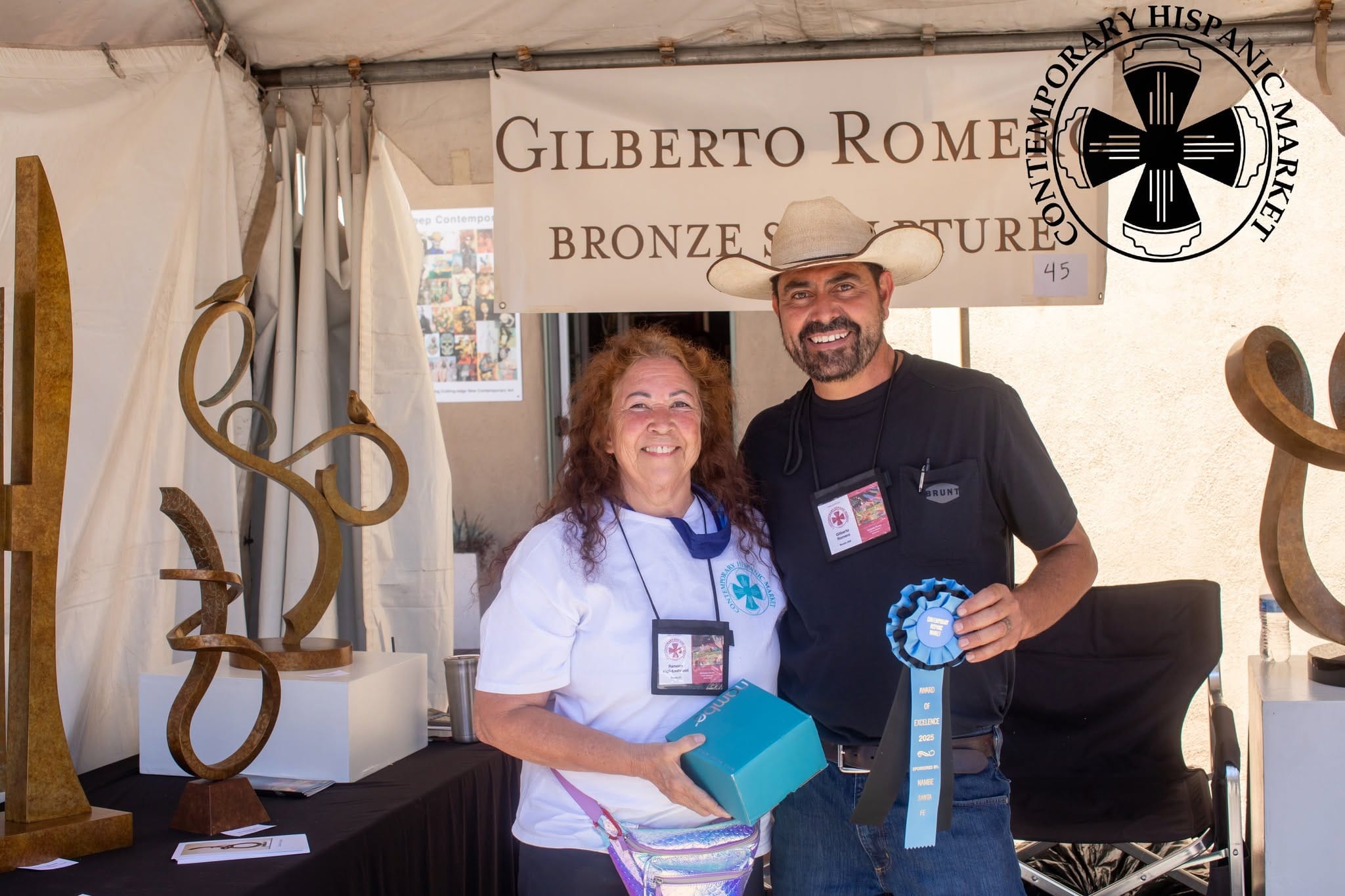
Santa Fe Contemporary Hispanic Market – Gilberto Romero.
🎨 What Is the Santa Fe Contemporary Hispanic Market?
The Contemporary Hispanic Market is the world’s largest contemporary Hispanic art market. It was founded in 1986 — quietly, almost rebelliously — by a small group of Hispanic artists who had something important to say but no traditional venue willing to say it with them.
The origin story matters. The first market took place in the courtyard of the Palace of the Governors with just 11 free-spirited artists displaying their work while, nearby on the Plaza, the Traditional Spanish Market celebrated age-old techniques and materials. Those 11 artists weren’t rejecting tradition — they were extending it. Taking the deep cultural roots of New Mexico’s Hispanic heritage and asking what those roots could grow into when given creative freedom.
Nearly four decades later, that small courtyard gathering has grown into a juried market featuring more than 130 artists across 18 categories, drawing collectors from across the United States and beyond. The mission remains exactly what it was in 1986: to provide Hispanic New Mexico artists a venue for contemporary expression, and to give collectors a rare opportunity to meet and buy directly from some of the most respected contemporary Hispanic artists working today.
Eligibility is meaningful. To participate, artists must be at least one-quarter Hispanic and a full-time resident of New Mexico. Every artist is reviewed by a jury. What you see at this market is authenticated, curated, and made by hand — often by artists whose families have shaped New Mexico’s cultural landscape for generations.
- 📅 Founded: 1986 — celebrating its 40th anniversary in 2026
- 🌎 Scale: World’s largest contemporary Hispanic market
- 🎨 Artists: 130+ juried artists across 18 categories
- ✅ Eligibility: At least one-quarter Hispanic; full-time New Mexico resident
- 🎟 Admission: Free and open to the public
- 🏛️ Location: Lincoln Avenue, north of the Historic Santa Fe Plaza
🗺️ Contemporary Hispanic Market vs. Traditional Spanish Market — What’s the Difference?
First-time visitors are often surprised to discover that two distinct art markets occupy the same weekend and nearly the same block. Understanding the difference between them doesn’t just help you navigate — it deepens your appreciation of both.
The Traditional Spanish Market, held on the Santa Fe Plaza itself since 1926, honors the preservation of Spanish Colonial art forms: retablos, bultos, tinwork, colcha embroidery, straw appliqué, and weaving in centuries-old styles, using historical materials and techniques. Every artist must demonstrate mastery of those traditional forms. It’s extraordinary — and deliberately bounded.
The Contemporary Hispanic Market celebrates what happens when that heritage meets creative freedom. As Ramona Vigil-Eastwood, president of the Contemporary Hispanic Market since 2006, puts it plainly: “We contemporary artists could never have a chance to get into that market, because we don’t do traditional work.” The Contemporary Market exists precisely to make space for the evolution of Hispanic artistic expression in New Mexico — honoring ancestry while refusing to be constrained by it.
| Feature | Traditional Spanish Market | Contemporary Hispanic Market |
|---|---|---|
| Founded | 1926 (100th year in 2026) | 1986 (40th year in 2026) |
| Location | Historic Santa Fe Plaza | Lincoln Avenue, north of the Plaza |
| Art Philosophy | Preservation of historical techniques and materials | Contemporary expression rooted in Hispanic heritage |
| Art Style | Retablos, bultos, tinwork, colcha embroidery, weaving | Painting, sculpture, photography, mixed media, ceramics, jewelry, writing, and more |
| Artist Eligibility | New Mexico Hispanic artist; mastery of traditional forms required | At least one-quarter Hispanic; full-time NM resident |
| 2026 Dates | July 25–26, 2026 | July 25–26, 2026 |
| Admission | Free | Free |
| Best For | Collectors of Spanish Colonial art; cultural history enthusiasts | Contemporary art collectors; first-time and return visitors alike |
Most visitors who attend one market spend time at the other. Moving between them across the weekend — from the disciplined traditions of the Plaza to the expressive energy of Lincoln Avenue — creates one of the richest cultural experiences Santa Fe has to offer. Plan for both.
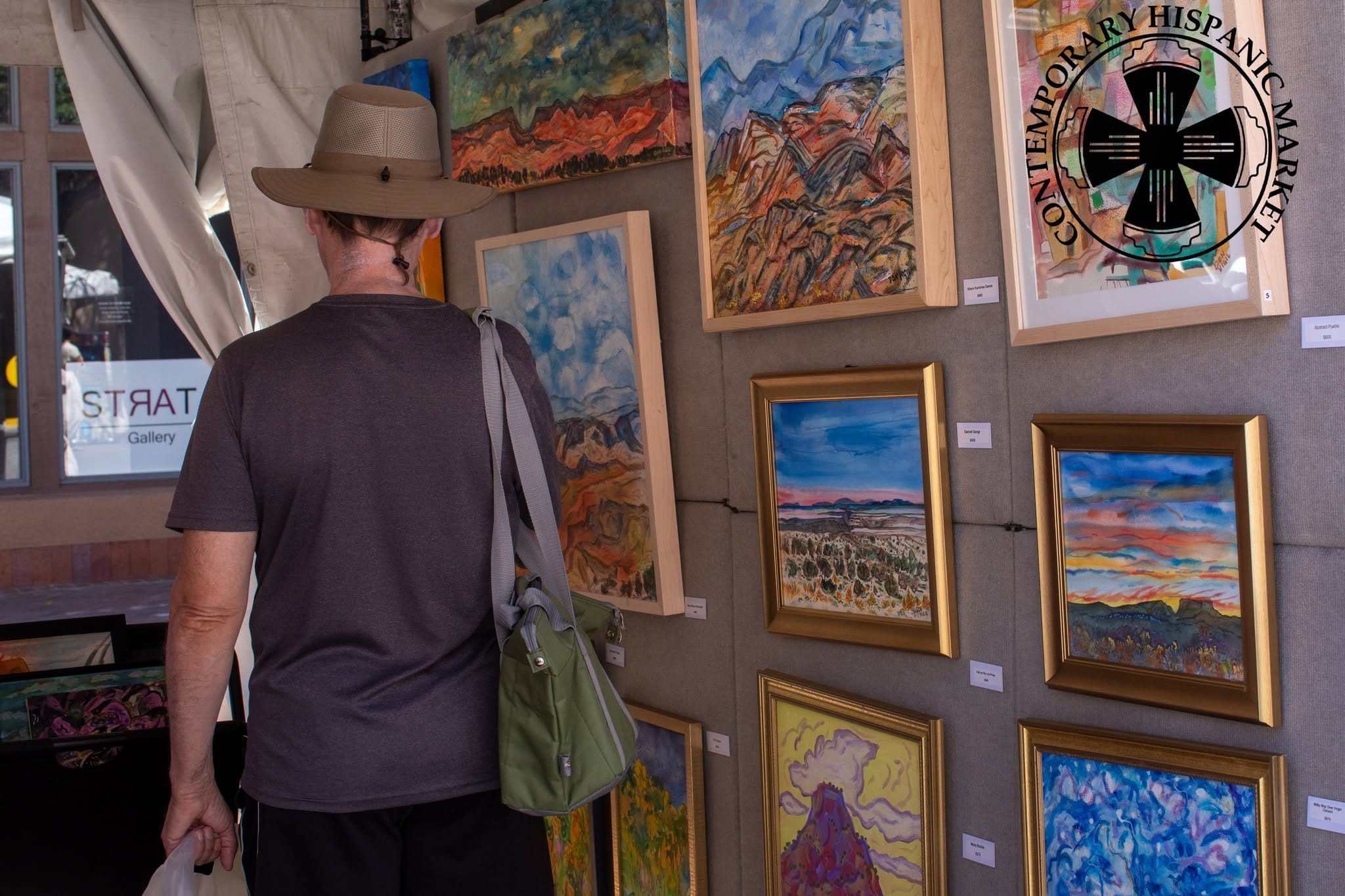
Santa Fe Contemporary Hispanic Market.
✨ What You’ll Find at the Market — Art, Mediums & Categories
The breadth of work at the Contemporary Hispanic Market is genuinely surprising on first visit. This is not a single-medium market. Eighteen juried categories span the full spectrum of contemporary artistic practice, all filtered through the unique lens of New Mexico Hispanic heritage and life.
🖌️ Painting
The largest category and the most varied. Oils, acrylics, watercolors, and mixed pigments — from abstract landscapes inspired by traditional color palettes to figurative work exploring contemporary Hispanic life in the Southwest. Some artists bridge the traditional and contemporary worlds in a single canvas.
🗿 Sculpture
Stone, bronze, wood, and found materials shaped into works that draw on ancestral techniques while speaking a thoroughly modern visual language. Gilberto Romero’s stone and bronze figures are among the most recognized in this category — expect a line at his booth early Saturday.
📷 Photography
Images capturing Hispanic life, landscape, and identity across New Mexico. Photography at this market tends toward the documentary and personal — portraits, communities, land — rendered with technical mastery and deep cultural intimacy.
🏺 Ceramics
Contemporary ceramic forms rooted in the pottery traditions of New Mexico — but unbound by them. Functional and sculptural work both appear, from wheel-thrown pieces with modern glazes to hand-built forms referencing ancient Pueblo and Spanish Colonial shapes.
💎 Jewelry
One of the most accessible categories for first-time buyers. Contemporary silver, gold, turquoise, and mixed-material pieces designed by Hispanic artists who bring a distinctly New Mexican sensibility — and personal cultural narrative — to wearable art.
🖨️ Printmaking
Hand-pulled serigraphs, woodblock prints, and lithographs — often the most affordable original art at the market. Jonathan Sanchez’s hand-pulled serigraphs are a perennial favorite. Prints offer serious art at accessible prices and travel home easily.
🧶 Textiles
Woven, sewn, and fiber-based works that draw on New Mexico’s rich weaving tradition while incorporating contemporary design thinking. From wall hangings to wearable pieces, the textile category consistently produces some of the most quietly stunning work in the market.
🎭 Mixed Media & More
Found object art, digital work, furniture, glass, wood burning, lucite sculpture, and — newest to the market — literary writing. Roger Martínez of Taos offers novels and paintings side by side, his historical fiction rooted in New Mexico mythology as much as any carved retablo.
The real gift of this market is the same as its traditional counterpart across the street: the artist is right there. You can ask what inspired a painting, how a lucite sculpture is carved, where a photographer traveled for a particular image. That direct conversation between maker and collector is irreplaceable — and it doesn’t happen at any gallery in the world quite the way it happens here.
Art categories at a glance:
🔨 The Silent Auction — A Hidden Highlight
One of the Contemporary Hispanic Market’s best-kept secrets is the silent auction running all weekend at the information booth. Artists from the current show donate original pieces specifically for the auction — work you won’t find anywhere else, at prices that often start well below gallery value.
Silent Auction Details
The auction opens Saturday morning and closes Sunday at approximately 1:00 PM. Stop by the information booth early Saturday to browse the donated pieces and place your bids — then return Sunday morning for a final look before bidding closes. Proceeds support the market and its artists.
Serious collectors often treat the silent auction as their first stop Saturday morning — before the booth crowds build. It’s also one of the genuinely social moments of the weekend: visitors compare notes, artists share which pieces they donated, and the informal energy is unlike anything else at the market.
💡 Insider Tips for First-Time Visitors and Serious Collectors
The Contemporary Hispanic Market rewards preparation. Here’s what seasoned visitors and collectors wish they’d known before their first visit.
⏰ Arrive Early Saturday
The most sought-after artists sell out — sometimes on Day 1. If you have specific artists or categories in mind, be at Lincoln Avenue when the market opens at 8:00 AM. The first hour Saturday is when collectors make their most important acquisitions.
💬 Talk to the Artists
This is not a gallery where conversation is discouraged. Artists are at their booths, they know their work deeply, and most love sharing the story behind a piece. Those conversations are part of what you’re buying — they travel home with the art.
💳 Bring Cash and Card
Most artists now accept credit cards, but smaller purchases and food vendors are easier with cash. ATMs are available near the Plaza. For large acquisitions, confirm payment method with the artist before you fall in love with something.
🌧️ Pack a Rain Poncho
It rains almost every year — briefly, intensely, and usually in the afternoon. Local tradition calls it “blessing the market.” It passes in 20 minutes, the sun returns, and the market goes on. Come prepared and you’ll enjoy the spectacle rather than scramble for cover.
🕶️ Dress for High Desert Summer
Santa Fe sits at 7,000 feet. July sun is intense. Bring sunscreen (SPF 30+), a wide-brim hat, and a refillable water bottle. Comfortable walking shoes matter — Lincoln Avenue and the Plaza are historic stone and uneven in places.
🛍️ Bring a Big Bag
You will buy more than you planned. A sturdy tote or two makes the day dramatically easier. For larger pieces — canvases, sculpture, framed work — ask the artist about packing and shipping options. Many can arrange it directly.
🎨 First-time collector’s checklist:
- Browse the official artist roster at contemporaryhispanicmarket.org before you arrive
- Note 3–5 artists you specifically want to see and go to them first Saturday morning
- Stop at the silent auction booth early — and again Sunday before 1:00 PM
- Ask every artist about their process — the stories make the pieces more valuable, not less
- Don’t negotiate pricing. These are juried, gallery-quality works priced by the makers themselves.
- Photograph pieces you’re considering — it’s easier to compare when you’ve seen 100 booths
🅿️ Logistics — Getting There, Parking, and Getting Around
The Contemporary Hispanic Market occupies Lincoln Avenue, running north from the Plaza between Palace Avenue and Federal Place. The Traditional Spanish Market fills the Plaza itself the same weekend, which means the entire downtown Santa Fe core is buzzing — and parking becomes a genuine challenge by mid-morning Saturday.
| Parking Option | Details | Best For |
|---|---|---|
| Sandoval Street Garage | 227 Sandoval St — short walk to the Plaza and Lincoln Ave | Early arrivals; fills fast by mid-morning |
| Convention Center Garage | 201 W Marcy St — approximately 15-minute walk to Lincoln Ave | Reliable backup when closer lots fill |
| Street Parking | Available around downtown but very competitive | Only if you arrive before 8:00 AM |
| Ride-Share | Uber and Lyft operate in Santa Fe; request drop-off a few blocks from Lincoln Ave | Practical for guests staying further from downtown |
| Walk from Fort Marcy | ~10 minutes on foot through the historic district | The easiest option — no parking stress whatsoever |
🔍 Local insight: Downtown road closures for the combined market weekend begin Thursday noon and run through Sunday. If you’re driving in from out of town, arrive Friday evening and get your bearings before the Saturday crowds. Better yet — stay walkable and skip the logistics entirely.
🌵 How to Do Both Markets in One Weekend
The last full weekend in July in Santa Fe is genuinely one of the great cultural weekends in the American Southwest. Two complementary markets, hundreds of artists, five centuries of artistic evolution on one block. Here’s how to make the most of it.
Saturday Morning — Contemporary First
Arrive at Lincoln Avenue at 8:00 AM when the Contemporary Hispanic Market opens. Go directly to the artists you researched in advance, visit the silent auction booth, and browse the full length of the market before crowds peak. This is when the best pieces are still available.
Saturday Mid-Morning — Cross to the Plaza
Walk the half-block to the Traditional Spanish Market on the Plaza. The contrast is immediate and striking — from contemporary abstraction to centuries-old devotional forms. Take your time. The artists here are equally willing to talk craft, history, and family legacy.
Saturday Afternoon — Rest and Explore
The hottest, most crowded stretch of the weekend. A perfect time for lunch at a Plaza restaurant, a walk up Canyon Road to visit galleries, or a return to your rental to rest before the evening. Make dinner reservations in advance — everything near the Plaza fills on market weekend.
Sunday Morning — The Unhurried Visit
Sunday is the hidden gem. Crowds thin noticeably, artists are relaxed and conversational, and the atmosphere shifts from electric to intimate. Return to any booths that caught your eye Saturday. The silent auction closes Sunday around 1:00 PM — don’t miss your final bids.
Beyond the markets themselves, the 2026 July weekend sits within Santa Fe’s richest stretch of summer programming. The International Folk Art Market at Museum Hill runs earlier in July. Canyon Road galleries host opening receptions through the summer. The Santa Fe Opera season is in full swing. If you have the flexibility to extend your stay, the days before and after market weekend are worth filling.
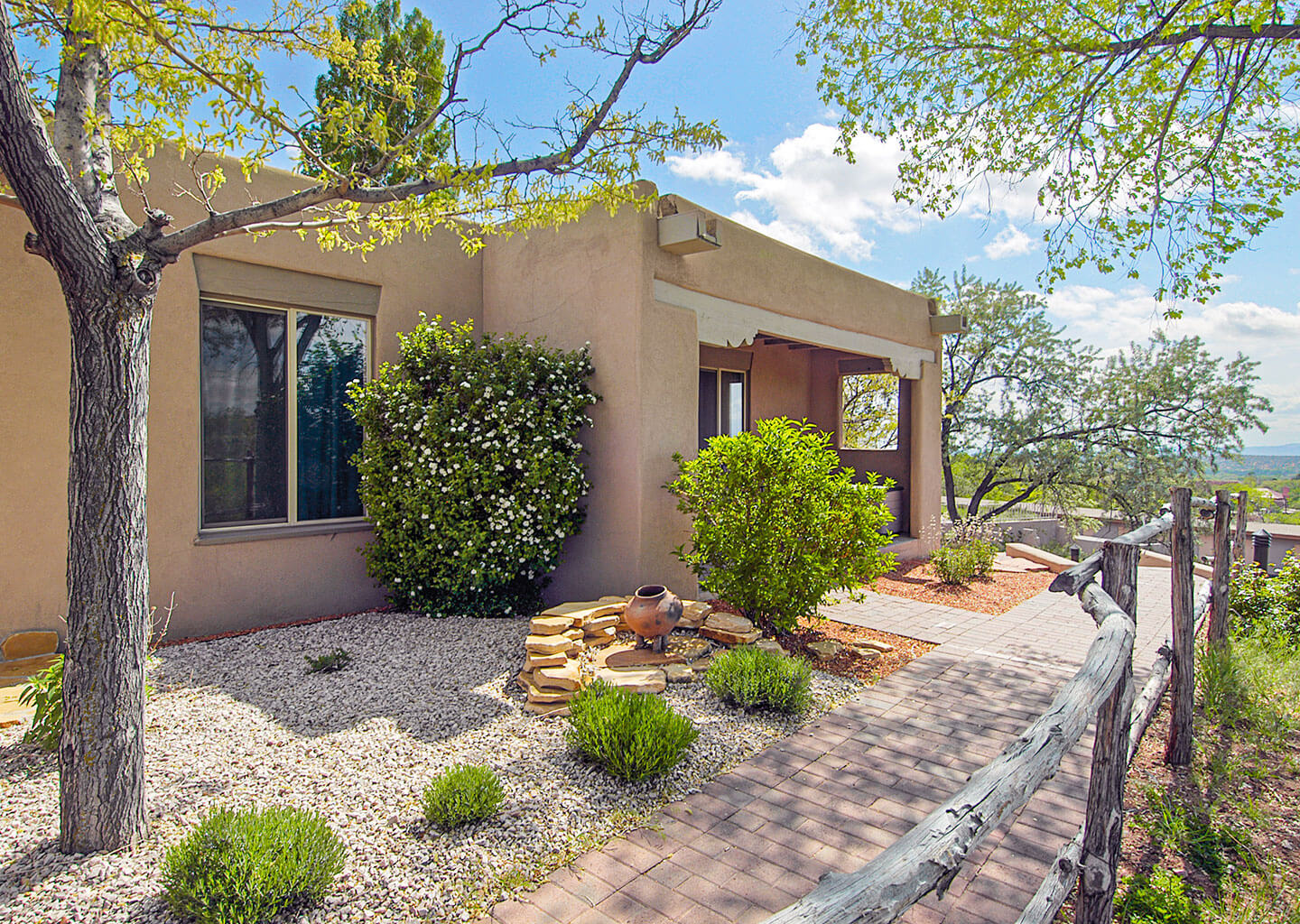
Santa Fe Vacation Rental Casita
🏡 Where to Stay for the Contemporary Hispanic Market 2026
Market weekend is one of the busiest weekends in the Santa Fe summer. The best properties near the Plaza move fast — often weeks in advance. If you are planning to attend in 2026, booking early is not optional. And where you stay changes your entire experience.
The difference between waking up a 10-minute walk from Lincoln Avenue and navigating downtown parking on the busiest morning of the year is the difference between a relaxed, immersive market weekend and a stressful one. We’ve seen guests miss the opening of the market because they couldn’t find parking. We’ve seen others walk out their front door and be browsing booths before 8:15 AM. The choice matters.
🏨 Fort Marcy Condos — Walk to the Market
Set on nine landscaped acres just above historic downtown Santa Fe, Fort Marcy Condos are the natural home base for Contemporary Hispanic Market weekend. Lincoln Avenue is a 10-minute walk from your door — downhill through the historic district, past the Cross of the Martyrs with its panoramic views over the city.
- ✓ ~10-minute walk to Lincoln Avenue and the Santa Fe Plaza
- ✓ 1-, 2-, and 3-bedroom condos with full kitchens
- ✓ Private balconies with panoramic Santa Fe views
- ✓ Next to the Cross of the Martyrs overlook
- ✓ Perfect for couples, families, and serious collectors
🏡 Quail Run — Resort Space and Amenities
For groups, families, or anyone who wants to return from a full day at the market to genuine resort-quality space, Quail Run is the answer. A gated community a short drive from the Plaza, with homes, townhomes, and condos that offer the kind of room-to-breathe no hotel can provide.
- ✓ Homes, townhomes, and condos in multiple sizes
- ✓ Resort amenities including pool and tennis courts
- ✓ Gated, tranquil high-desert community
- ✓ Short drive to Lincoln Avenue and the Plaza
- ✓ Ideal for larger groups and extended Santa Fe stays
Book with Confidence
We understand that your Santa Fe vacation represents a real investment — in time, in planning, in the experience itself. Every booking through All Seasons Resort Lodging comes backed by our full guest programs:
- 🔒 Lowest Rate Guarantee — we match any lower price you find
- ↩️ 48-Hour Money-Back Guarantee — risk-free booking window after you reserve
- 🛡️ Travel Protection Plan — trip insurance and coverage when plans change
- 💙 True Blue Perks — 10% returning guest discount for your next visit
📅 Also Happening That Weekend — The Full Picture
The last full weekend of July in Santa Fe is not a single-market weekend. It is one of the most culturally dense weekends of the year in the American Southwest. Here’s what else surrounds the Contemporary Hispanic Market.
| Event | Dates | Location | Admission |
|---|---|---|---|
| Traditional Spanish Market | July 25–26, 2026 | Historic Santa Fe Plaza | Free |
| Contemporary Hispanic Market | July 25–26, 2026 | Lincoln Avenue, Santa Fe | Free |
| Canyon Road Gallery Scene | Year-round; summer openings on Fridays | Canyon Road, Santa Fe | Free |
| Museum of Spanish Colonial Art | Open daily | Museum Hill, Santa Fe | Ticketed |
| Santa Fe Opera | June–August 2026 | Opera House, north of Santa Fe | Ticketed |
| Santa Fe Indian Market | August 2026 | Historic Santa Fe Plaza | Free |
Attending the Santa Fe Indian Market in August as well? Our Santa Fe vacation rentals are available across the full summer season — booking both weekends in the same property means familiarity, comfort, and often a better rate for extended stays.
❓ Frequently Asked Questions — Santa Fe Contemporary Hispanic Market 2026
When is the Santa Fe Contemporary Hispanic Market in 2026?
The Contemporary Hispanic Market takes place on Saturday, July 25 and Sunday, July 26, 2026, from 8:00 AM to 5:00 PM both days. It runs simultaneously with the Traditional Spanish Market on the same weekend.
Is the Contemporary Hispanic Market free to attend?
Yes — admission is entirely free and open to the public. The Traditional Spanish Market on the Plaza the same weekend is also free. Your budget goes toward art purchases and food from on-site vendors.
Where exactly is the Contemporary Hispanic Market located?
The market is held on Lincoln Avenue, north of the Historic Santa Fe Plaza, between Palace Avenue and Federal Place. It is adjacent to — but distinct from — the Traditional Spanish Market, which occupies the Plaza itself.
What’s the difference between the Contemporary Hispanic Market and the Traditional Spanish Market?
The Traditional Spanish Market (founded 1926) celebrates preservation of Spanish Colonial art forms using historical techniques. The Contemporary Hispanic Market (founded 1986) celebrates the evolution of Hispanic artistic expression — contemporary painting, sculpture, photography, ceramics, and more. Both are free and happen the same weekend. Most visitors attend both.
Can I buy art directly from the artists?
Yes — and that’s one of the great things about this market. Every artist is present at their booth. You purchase directly from the maker, which means the conversation about process, inspiration, and story comes with the piece. Some artists sell out on Day 1, so arrive early Saturday if there are specific artists or categories you want to see.
What should I bring to the Contemporary Hispanic Market?
Sunscreen and a hat (7,000-foot elevation, intense July sun), comfortable walking shoes, a refillable water bottle, cash and a card, a large tote bag for purchases, and a rain poncho — it rains briefly most years, typically in the afternoon, and passes quickly. The locals call it a blessing on the market.
Is 2026 a special year for the Contemporary Hispanic Market?
Yes — 2026 marks the 40th anniversary of the Contemporary Hispanic Market, founded in 1986. It also coincides with the 100th anniversary of the Traditional Spanish Market next door, making the last full weekend of July 2026 one of the most historically significant art market weekends in Santa Fe’s history.
Where is the best place to stay for the Contemporary Hispanic Market?
Fort Marcy Condos are the most walkable option — about 10 minutes on foot to Lincoln Avenue. Quail Run offers resort amenities and larger homes for groups, a short drive from downtown. Both are managed by All Seasons Resort Lodging and available to book direct with our Lowest Rate Guarantee.
Reserve Your Santa Fe Art Market Weekend
July 25–26, 2026 brings two landmark celebrations to Santa Fe simultaneously — the 40th Contemporary Hispanic Market and the 100th Traditional Spanish Market. Fort Marcy Condos put you 10 minutes from all of it, on foot. Our local team is here to help you make the most of every moment in Santa Fe.
Questions? Call us 7 days a week: 888-575-2775 • 9 AM – 5 PM Mountain Time • reservations@asrlodging.com

![Your Guide To Park City Mountain Lift Tickets [2026-2027]](https://www.allseasonsresortlodging.com/wp-content/uploads/2026/09/park-city-canyons-spring-skiing-2025-90.jpg "Your Guide To Park City Mountain Lift Tickets [2026-2027]")